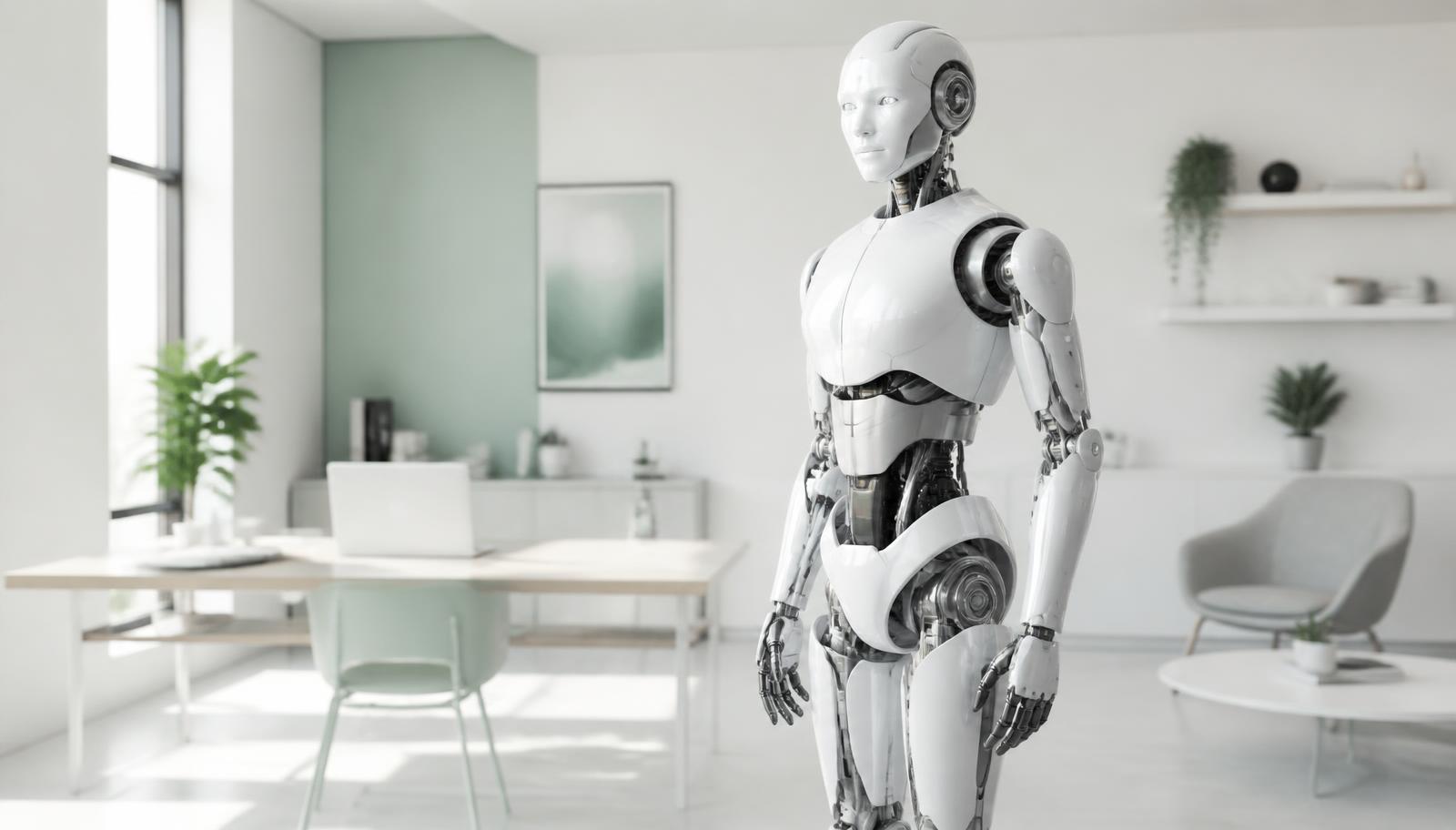
On the surface level, it seems straightforward to define what constitutes a humanoid robot. It has the physical form of a human being: two arms, two legs, a torso, and a head, right?
Yes, to a point. But adopting a pragmatic definition, focused on what they can do for companies, casts a stronger light on their evolving capabilities and future potential.
Below, we explore what these machines are, what they can do, their history, where the technology stands today, and what comes next.
The early history of humanoid robotics
Humanoids have a long history in literature and films. However, their physical, technical reality is somewhat shorter.
The real beginnings are hard to pinpoint, but it is often said that the earliest humanoids emerged from Japan.
One example is Waseda University's WABOT-1 from 1973, which is often recognised as the first full-scale humanoid. WABOT-1 could walk and was able to grasp objects. As such, it represented a genuine engineering achievement.
More well-known are Honda's early endeavours. Starting in 1986, the company quietly worked through a series of internal prototypes before revealing ASIMO to the world in 2000.
ASIMO quickly became the defining symbol of humanoid robotics, with its ability to run, climb stairs, shake hands, and pour a drink. In spite of being the result of 36 years of R&D, it was never fully deployed and was retired in 2022.
In the meantime, other early-stage humanoid robots began emerging, including Softbank's Pepper, and the early versions of Boston Dynamics' Atlas.
Simultaneously, the DARPA Robotics Challenge pushed the field forward technically, as participating teams strove to solve navigation, manipulation, and perception problems in realistic scenarios.
While the footage of robots falling over became iconic, the engineering progress, less visible at the time, proved more important.
Three defining steps for humanoids
The trajectory of humanoid robotics changed fundamentally as three forces converged, roughly between 2016 and 2022.
Deep learning methods grew at exponential speeds, dramatically improving robotic perception and task learning; actuator and battery hardware became meaningfully more capable with falling prices; and compute costs fell sharply.
One of the biggest changes that has emerged since is Vision-Language-Action models (VLAs). These models integrate visual perception, language understanding, and physical action into a single system. VLA-based robots can learn from demonstrations and generalise to similar tasks it has not been explicitly trained on. The analogy is large language models in text AI.
According to the Robotics Center of Silicon Valley's State of Robotics 2026 report, VLA adoption tripled between 2025 and 2026 and is now present in 40% of all new commercial robot deployments.
Growing commercial viability
The lower prices and increasing capabilities have led to early commercial deployments.
One example is BMW's Spartanburg plant in the United States, where a Figure 02 humanoid robot has worked ten-hour daily shifts over ten months in active vehicle production, supporting the manufacture of more than 30,000 BMW X3s.
In logistics, Agility Robotics' Digit has operated in live GXO and Amazon warehouses under multi-year commercial contracts. In Japan, JAL has announced a three-year humanoid deployment at Haneda Airport for baggage loading and container transport.
Perhaps most impressive of all has been the emergence of several Chinese manufacturers, led by Unitree, who have pushed the capabilities and prices of humanoids to points where they are viable options for a broad range of tasks.
Investment reflects the potential of humanoids, with humanoid-specific funding reaching $4.3 billion by the end of 2025. Global venture investment across robotics reached $9.4 billion in 2025, up 41% over 2024.
Defining what makes a robot a humanoid
Given their potential, it might come as a surprise that some confusion surrounds the term "humanoid robot," and agreeing on a definition is challenging.
One approach is anatomical: a humanoid robot is a bipedal machine with a torso, two arms, a head, and two legs, built to the proportions of the human body. This is the definition most people have in mind when they picture humanoids, and the form factor definition dominates most media coverage.
But some robots described as humanoids pair a human-like upper body (torso, head, two arms) with a wheeled base rather than legs. SoftBank's Pepper is a well-known example. The RobOdin platform, being developed by SDU and Novo Nordisk in Denmark, takes the same approach.
A third configuration removes mobility from the equation entirely. Fixed-base upper-body platforms (a torso, arms, and hands mounted on a stable foundation) are used in structured manufacturing cells where the robot does not need to travel between locations.
So, perhaps a purely anatomical definition is too narrow to be useful.
A more pragmatic definition focuses on function rather than form. In this view, a humanoid robot is one that can navigate and operate as a human in spaces designed for humans.
For companies and organisations, this pragmatic rather than anatomical definition provides a clearer starting point for evaluating what humanoid robots can do for you. That is a key reason why HIVERobots tends to use this definition.
For us, a robot can move through a standard human environment (like an office or retail space) without infrastructure modification, manipulate objects using its effectors (hands) or tools and fixtures, perform tasks at the scale and in the context where humans currently work, then it qualifies as a humanoid in a commercially meaningful sense.
What the Road Ahead Looks Like
Using the pragmatic definition provides a good platform for evaluating where the technology is today, and where it is headed.
The tasks where humanoid robots are creating genuine value today tend to be specific, including high-volume, physically repetitive work in structured environments, like shelf replenishment or similar functions across retail, offices, manufacturing and production. That is list is growing exponentially for a number of reasons.
Firstly, the economics keep improving, as prices drop. Data from Unitree Robotics suggests the average price of its robots fell by more than 70% over two years, from 2023 to 2025. IDTechEx figures from May 2026 project average selling prices to fall 68% by 2030. Under high-utilisation conditions, the payback period for a deployed unit can be as little as six months today – and will be even shorter in the near future.
But hardware tells only part of the story. The more significant shift has been on the software side. VLA models have moved forward at incredible speeds, and is one of two software-focused reasons why deployment is accelerating.
The Robotics Center of Silicon Valley's State of Robotics 2026 report points to a significant finding: the EgoScale paper, published in February 2026, provided the first strong empirical evidence that robotics foundation models follow the same data-driven scaling laws as large language models. In other words, companies accumulating the most data have self-reinforcing advantages. A company that pilots a humanoid robot today is not simply testing hardware — it is generating task demonstration data that trains the AI to work better in its specific environment.
The second part of the equation is the software that enables robots to perform specific tasks. You can think of it as VLAs being the school system (this is how we learn) and the software being the individual student (this is what I am being taught, and what I can do with that).
It is not a perfect image, but it gives you an idea of why the boundaries of what humanoids can do will keep expanding based more on what they learn and do with that knowledge than on how they are built. In that way, they are much like the humans they will soon collaborate with in factories, retail shops, and offices.
Want to see this in your own operation?
We help companies identify where humanoid robots create real value, and prove it with data.